Recent Graduate Resume: Examples, Format and Tips for Your First Job
A strong resume for a recent graduate does one thing well: it proves you can do the basic work of the job even though you have not held it yet. You do that by putting your education first, turning internships, projects and part-time jobs into achievement bullets, and matching the words in the entry-level posting. This guide on how to write a resume as a recent graduate shows you the exact section order, two complete sample layouts and more than ten before-and-after bullets you can adapt.
The short answer
- Keep it to one page and put Education right after your summary for the first 0-2 years.
- Treat projects, internships, campus jobs and leadership roles as experience, with results in every bullet.
- Add a skills section with the tools named in the posting, and tailor the resume to each application.
If you want the general rules that apply to every resume (fonts, margins, file types, contact details), our guide on how to make a resume covers them. This page focuses on what is different when your degree is newer than your work history.
Recent graduate resume format: what goes first
Recruiters read a resume top to bottom and decide quickly whether to keep going. For someone with ten years of work, the most persuasive thing is their last job. For you, it is usually the degree you just earned, plus the projects and internships that show you can apply it. That is why the section order changes.
Use this order if you graduated in the last two years or are finishing your final semester:
- Header: name, city and state, phone, professional email, LinkedIn and a portfolio or GitHub link if relevant.
- Summary: two lines stating your degree, the role you are targeting and your strongest proof point.
- Education: degree, school, graduation date, honors and relevant coursework.
- Experience: internships, co-ops, part-time jobs and research positions.
- Projects: capstone, class, hackathon or personal projects with outcomes.
- Leadership and activities: clubs, student government, volunteering, athletics.
- Skills: technical tools, languages and certifications.
Swap Projects above Experience when your projects are more relevant than your jobs. A computer science graduate whose only job was at a coffee shop should lead with the app they built, not the espresso machine. The rule is simple: whatever best proves you can do the target job goes highest.
When to move Education down
How to list education on a resume for a recent graduate
Your Education section carries more weight than it will at any other point in your career, so give it more detail than a single line.
Degree, school and date
Write the full degree name and major, for example Bachelor of Science in Marketing, then the school, city and graduation month and year. If you have not graduated yet, write Expected May 2027. Add a minor or a double major on the same line or the next one.
Honors and awards
Dean's List, Latin honors, scholarships and departmental awards go on one line under the degree. Name the semester count if it is impressive ("Dean's List, 6 of 8 semesters") and give scholarships a short reason when it is merit based.
Relevant coursework
List four to six courses that match the job, not your full transcript. Advanced or applied courses beat introductory ones: Financial Statement Analysis tells an accounting recruiter more than Principles of Accounting I. If the course produced a notable project, move that project into the Projects section and describe it properly.
GPA: include it only when it helps
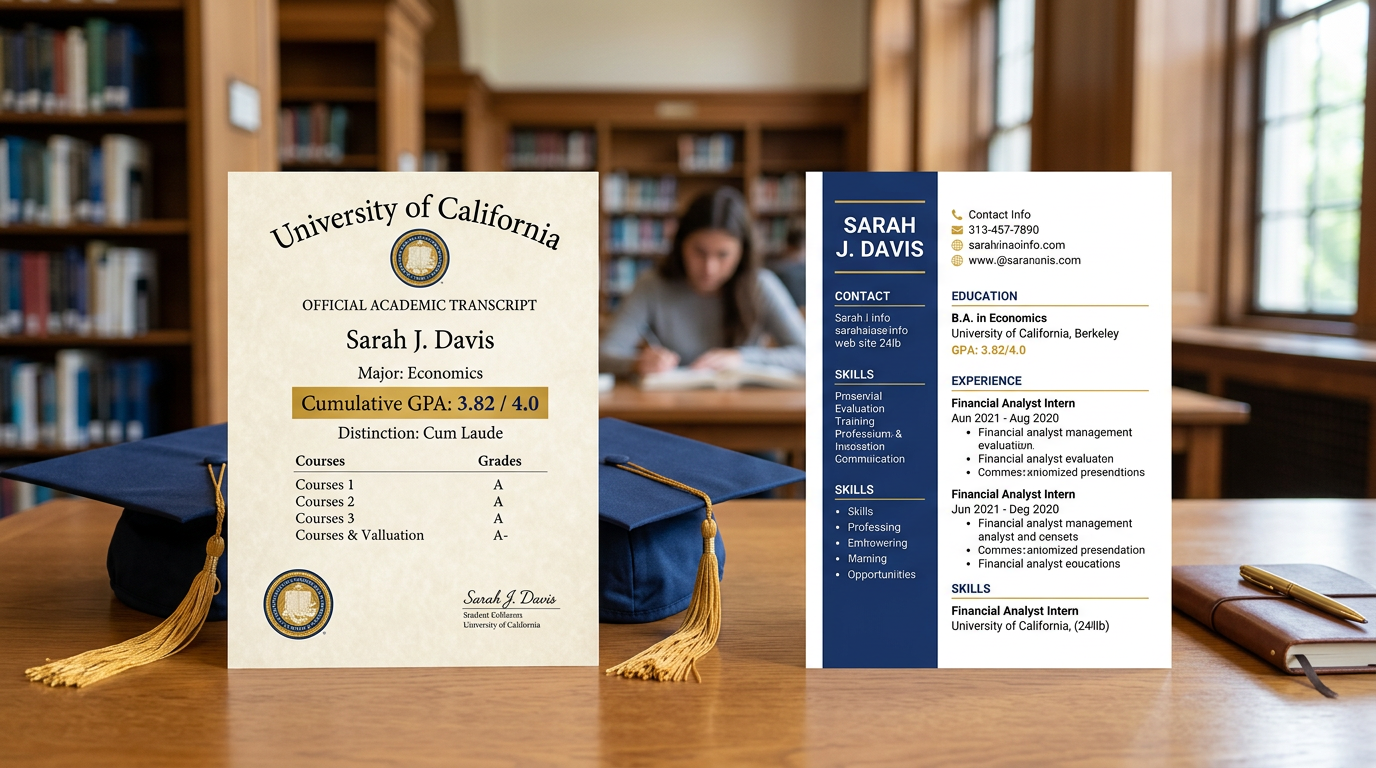
A common rule is to include your GPA if it is 3.5 or higher, or if the posting asks for it (many finance, consulting and engineering employers do). If your overall GPA is lower but your major GPA is strong, list "Major GPA: 3.6". Leave it off otherwise. We cover the edge cases in detail in should I put my GPA on my resume.
Turn every experience into achievement bullets
The biggest mistake on a recent graduate resume is listing duties. "Responsible for greeting customers" tells a recruiter what the job was, not what you did with it. Each bullet should follow the same pattern: action verb + what you did + measurable result. If you cannot measure it, describe the scale (how many people, how much money, how often) or the outcome (what changed because of you).
Internships and co-ops
These are your most valuable lines because they are the closest thing to the job you want. Name the team, the tools and the deliverable. If your work was used by someone (a report the manager presented, a feature that shipped, a process the team adopted), say so.
Part-time and campus jobs
A job outside your field still proves reliability, customer skills and the ability to handle a schedule next to a full course load. Pick the one or two bullets that transfer: training new hires, handling cash, resolving complaints, improving a process. Mention that you worked a set number of hours per week while studying; it is a real signal of time management.
Academic and personal projects
Write projects exactly like jobs, with a title, a date and two or three bullets. Include the team size, your specific role, the tools and the outcome: a grade, a client decision, a number of users, a ranking in a competition. Link to the live project or repository when you have one.
Leadership, clubs and volunteering
Being "member of the Marketing Club" is filler. Being treasurer who managed a budget, organizer of an event with a known attendance or the volunteer who recruited and scheduled other volunteers is experience. Keep only the roles where you did something you can describe with a result.
Upload what you have (even a list of classes, projects and campus jobs) and GetQuickResume turns it into an ATS-ready one-page resume. The AI asks about gaps instead of inventing experience you do not have.
12 entry-level bullet examples (before and after)
Use these as templates. Replace the numbers with your own real figures; an honest small number is far better than an invented big one, and interviewers will ask about it.
Weak
Worked on a group project for marketing class.
Strong
Led a 4-person team that built a social media plan for a local bakery; the owner adopted 3 of 5 recommendations and grew Instagram followers 22% in two months.
Weak
Intern in the finance department.
Strong
Reconciled 300+ vendor invoices per month in NetSuite during a summer finance internship, flagging $14K in duplicate payments.
Weak
Cashier at a grocery store.
Strong
Processed 150+ transactions per shift with a 100% cash drawer accuracy record while working 20 hours per week during classes.
Weak
Made a website for a class.
Strong
Built a React and Firebase study-group finder for a software engineering capstone; 140 students signed up in the first semester.
Weak
Tutor at the writing center.
Strong
Tutored 60+ undergraduates per semester in academic writing; 9 of 10 students rated sessions "very helpful" in center surveys.
Weak
Treasurer of the Economics Club.
Strong
Managed a $6,500 annual budget as Economics Club treasurer and secured $2,000 in new sponsorship from two local firms.
Weak
Research assistant in a biology lab.
Strong
Ran 200+ PCR assays and maintained sample logs for a faculty study on soil bacteria, cited as a contributor in the published poster.
Weak
Helped with events as a volunteer.
Strong
Recruited and scheduled 25 volunteers for a campus food drive that collected 1,800 pounds of food for the county pantry.
Weak
Data analysis project using Python.
Strong
Analyzed 5 years of city bike-share data in Python (pandas, matplotlib) and presented station-rebalancing recommendations to the transportation department.
Weak
Server at a restaurant.
Strong
Trained 6 new servers on menu and POS procedures at a 120-seat restaurant and earned a top-3 ranking in monthly upsell sales.
Weak
Marketing intern, did social media.
Strong
Wrote and scheduled 45 LinkedIn posts in a summer marketing internship, raising average engagement rate from 1.8% to 3.1%.
Weak
Resident assistant in a dorm.
Strong
Supported 42 first-year residents as an RA, ran 8 community events per semester and resolved roommate conflicts with zero escalations to housing staff.
The skills section on an entry-level resume
Your skills section is where applicant tracking systems and recruiters check for the tools named in the posting. Keep it to hard, verifiable skills grouped by type, and drop soft skills like "hard worker" or "team player"; prove those in your bullets instead.
Example skill groups for a business graduate
Only list tools you could use in a test on your first day. If the interview includes a skills test, you will be asked.
- Excel (pivot tables, XLOOKUP)
- SQL
- Tableau
- Salesforce
- Google Analytics 4
- PowerPoint
- Spanish (fluent)
- Google Ads Search Certification
If you have a language, list your level honestly (native, fluent, professional working proficiency, conversational). Certifications that you completed, such as Google Analytics or AWS Cloud Practitioner, can sit here or in their own small section.
Resume examples for recent graduates
Below are two complete resume examples for recent graduates. The first has no professional experience and leans on projects. The second has one internship, which moves up and gets the most space.
Example 1: No professional experience, project-heavy
Jordan Lee
Data Analyst (Entry Level) · Columbus, OH · jordan.lee@email.com · github.com/jordanlee
Summary
Statistics graduate with hands-on Python and SQL experience from three applied data projects, including a city transportation analysis used by a public agency. Seeking an entry-level data analyst role.
Education
B.S. in Statistics, Minor in Computer Science · The Ohio State University · May 2026
GPA 3.7 · Dean's List, 6 semesters
Relevant coursework: Regression Analysis, Database Systems, Data Visualization, Machine Learning Fundamentals
Projects
Bike-Share Demand Analysis · Capstone · Jan-Apr 2026
- Cleaned and analyzed 5 years of trip data (2.1M rows) in Python with pandas and matplotlib.
- Presented station-rebalancing recommendations to the city transportation department; 2 stations were relocated.
Campus Dining Waste Dashboard · Team of 3 · Fall 2025
- Built a Tableau dashboard from SQL queries on 18 months of dining hall inventory data.
- Identified 3 menu items driving 40% of food waste; dining services cut their batch size the next term.
Leadership
Vice President, Statistics Club · 2024-2026
- Organized 6 R and Python workshops per year with average attendance of 35 students.
Work
Library Circulation Assistant · OSU Libraries · 2023-2026, 15 hrs/week
- Handled 100+ checkouts and patron questions per shift and trained 4 new student staff.
Skills
Python (pandas, scikit-learn), SQL, R, Tableau, Excel, Git
Example 2: One internship
Maria Gonzalez
Marketing Coordinator · Austin, TX · maria.gonzalez@email.com · linkedin.com/in/mariagonzalez
Summary
Marketing graduate with a summer internship in B2B content marketing, where I raised LinkedIn engagement from 1.8% to 3.1%. Bilingual English and Spanish, skilled in HubSpot and Google Analytics 4.
Education
B.B.A. in Marketing · The University of Texas at Austin · May 2026
Relevant coursework: Digital Marketing Analytics, Consumer Behavior, Brand Management, Marketing Research
Experience
Marketing Intern · Brightline Software, Austin, TX · Jun-Aug 2025
- Wrote and scheduled 45 LinkedIn posts, raising average engagement rate from 1.8% to 3.1%.
- Built 3 HubSpot email nurture sequences for trial users; the best performer reached a 34% open rate.
- Compiled a competitor pricing analysis of 8 vendors used by the sales team in Q4 planning.
Barista · Campus Coffee Co. · 2022-2026, 20 hrs/week
- Trained 5 new hires and ran the shop's Instagram account, growing it from 600 to 2,400 followers.
Projects
Rebrand Strategy for a Local Nonprofit · Brand Management course · Spring 2026
- Led a 4-person team on audience research and a new messaging guide that the nonprofit adopted for its 2026 campaign.
Skills
HubSpot, Google Analytics 4, Canva, Hootsuite, Excel, Spanish (native)
Notice that both examples keep to one page, put the strongest proof in the summary and give every bullet a number or an outcome. Jordan has no internship, but the capstone project with a public agency does the same job.
Summary vs. objective for recent graduates
Most graduates should use a short summary: two lines that say what you studied, what you can do and one proof point. It reads as an offer. An objective states the role you are pursuing and is useful when you are applying to a specific program (a rotational analyst program, a residency, a graduate trainee scheme) or when your degree does not obviously point to the job.
Self-focused objective
Recent graduate seeking a challenging position where I can grow my skills and advance my career.
Value-focused summary
Accounting graduate (B.S., May 2026) with a summer audit internship and hands-on experience in QuickBooks and Excel; passed the first section of the CPA exam.
If you do go with an objective, our resume objective tips show how to write one in two sentences that still focus on what you bring.
Tailor your resume to entry-level postings
Entry-level postings often receive a large number of applicants with similar degrees, so small differences matter. The fastest way to stand out is to mirror the specific skills and terms in the posting, using the exact wording where it is true for you.
- Highlight the requirements. Mark every tool, skill and qualification in the posting.
- Match the wording. If the posting says "data visualization" and you wrote "charts", use their term. Our guide to resume keywords explains how to find and place them.
- Reorder bullets. Move the project or internship bullet that matches the top requirement to the top of its section.
- Adjust the summary. Name the role title from the posting and the one proof point most relevant to it.
- Check the result. Run it through a free ATS resume checker to see which keywords and sections still need work.
See your ATS score for sections, keywords, action verbs and quantified results, plus the fixes that raise it. No account, no email, no card.
Doing this by hand for every application takes time. If you would rather paste the posting and get a tailored version with your match score before and after, see how to tailor your resume to a job description.
Mistakes that sink graduate resumes
- Listing duties instead of results ("responsible for", "helped with").
- A two-page resume padded with every club and course.
- Skills you could not demonstrate in an interview.
- An unprofessional email address or a missing city and state.
- Sending the same resume to every posting without changing the summary or keywords.
Paste the job posting and get a version of your resume rewritten for it: summary, achievements and skills, with your match score before and after. The AI asks about gaps instead of inventing experience.
Your first resume does not need years of experience. It needs a clear order, honest numbers and the words the employer is looking for. Start with Education, write every project and job as an achievement, and adjust the top third for each posting. That is enough to get you into the interview, where the real conversation starts.
Frequently Asked Questions
What should a recent graduate put first on a resume?
Put your contact details, then a two-line summary, then Education. For the first one to two years after graduation your degree is usually your strongest credential, so it belongs above experience. Once you have a full-time role that matches the jobs you want, move Experience above Education.
How long should a recent graduate resume be?
One page. A recruiter screening entry-level candidates is looking for proof you can do the basics of the job, and one tight page shows that better than two padded ones. If you are struggling to fill a page, add a project or a relevant course with a concrete outcome rather than enlarging the font.
Can I put class projects on my resume if I have no work experience?
Yes, and you should. Give them their own Projects section and write them like jobs: what you built or analyzed, the tools you used and the result, such as a grade, a user count, a client decision or a competition placement. Capstone and team projects with a real client are especially strong.
Should a recent graduate use a resume objective or a summary?
A short summary usually works better because it describes what you offer: your degree, two or three skills and one proof point. An objective can work when you are targeting a specific program or rotational role, as long as it says what you bring and not only what you want.
Should I include high school on my college graduate resume?
No. Once you have a college degree, or are about to finish one, high school adds nothing a recruiter needs. The rare exception is a high school achievement that is directly relevant and impressive, such as a national award in your field, which can go in an Honors line.
Ready to Create Your Professional Resume?
Upload the resume you already have or start from scratch. GetQuickResume's AI gives you an ATS-ready resume in minutes.
Start Free - No Credit CardGetQuickResume Team
Career & Resume Experts
Our team of HR professionals and career coaches share insights to help you land your dream job. We combine industry expertise with AI technology to make resume building effortless.
Related Articles
Resume Objective Tips: When to Use One and How to Write It
When a resume objective is worth including, how to write one in two sentences, the mistakes that make recruiters skip it, and short examples for common situations.
Should I Put My GPA on a Resume? When It Helps and When It Hurts
Wondering if including your GPA will help or hurt your chances? Learn the definitive rules for when to list your GPA, major GPA vs cumulative, and what alternatives to use.
Keywords in a Resume: Examples by Skill and Where to Put Them
What resume keywords are, how to pick the right ones from a job posting, where to put them, and 150+ keyword examples for skills, tools and industries that pass ATS and impress recruiters.