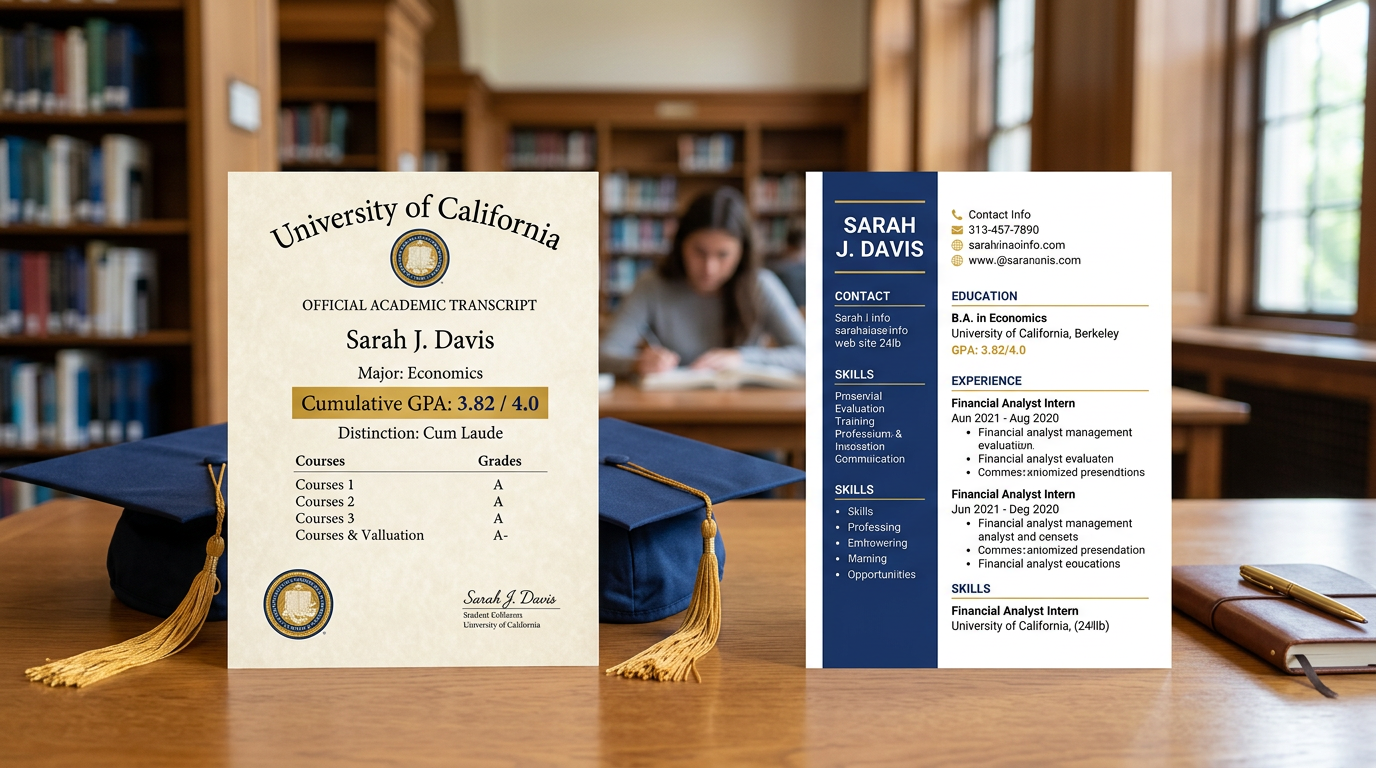
Should I Put My GPA on a Resume? When It Helps and When It Hurts
One of the most debated resume questions is whether to include your Grade Point Average (GPA). The short answer: it depends. Your GPA can either strengthen your candidacy or hurt your chances, depending on when you include it and what it reveals about your qualifications.
This guide provides clear, definitive rules for when to list your GPA, when to leave it off, and what alternatives to use when your GPA doesn't tell your full story.
When to Include Your GPA
Including your GPA makes sense in specific situations where it adds value to your candidacy:
Scenario 1: You're a Recent Graduate (Within 2-3 Years)
If you graduated within the last 2-3 years, your GPA is still relevant to employers. At this stage, you likely have limited professional experience, and academic performance serves as a proxy for your capabilities.
Include Your GPA If:
- •You graduated within the last 2-3 years
- •Your GPA is 3.5 or higher on a 4.0 scale
- •You're applying to your first or second professional role
- •The employer specifically requests academic credentials
Scenario 2: You Have an Exceptional GPA
A GPA of 3.5 or above is generally considered worth highlighting. Here's the breakdown:
Definitely Include
Summa/Magna Cum Laude
Include
Cum Laude
Optional
Consider Major GPA
Omit
Use Alternatives
Scenario 3: You're Applying to Academia or Research
For graduate school applications, research positions, or academic roles, GPA carries significantly more weight. Include it regardless of years of experience unless you have substantial professional accomplishments that overshadow academic metrics.
Scenario 4: The Job Listing Requests It
Some employers, particularly consulting firms, investment banks, and competitive entry-level programs, specifically request GPA information. Always include it when explicitly asked — omitting it may disqualify you.
Unsure whether to include your GPA? GetQuickResume's AI analyzes your situation and recommends the best approach for your specific career stage and target role.
When to Leave Your GPA Off
Sometimes including your GPA does more harm than good. Here's when to exclude it:
Scenario 1: You Graduated More Than 3 Years Ago
Omit Your GPA When:
- •More than 3 years have passed since graduation
- •You have substantial professional experience (5+ years)
- •Your GPA is below 3.0 on a 4.0 scale
- •Your work achievements tell a stronger story than grades
After 3 years in the workforce, your professional accomplishments matter far more than your college grades. Recruiters care about what you've achieved in real-world settings more than how you performed in academic settings years ago.
Scenario 2: Your GPA Is Below 3.0
A GPA below 3.0 raises red flags without adding value. Unless you're applying to a field where GPA is mandatory (like some consulting firms), leave it off and focus on other strengths.
Important: Some online application systems require GPA input. You may need to enter it in forms even if it doesn't appear on your resume document. Always answer application questions honestly.
Scenario 3: You Have a Strong Professional Track Record
If you have impressive work achievements, promotions, or measurable impact, let those speak for you. Professional success trumps academic performance in almost every industry after your first few years.
Scenario 4: You're Changing Careers
If your GPA relates to a field you're leaving, it may not be relevant to your new direction. Focus on transferable skills and relevant experience instead.
Major GPA vs. Cumulative GPA
Did you excel in your major courses but struggled with general education requirements? You may have the option to list your Major GPA instead of your cumulative GPA.
When to Use Major GPA
Consider Major GPA If:
- Your major GPA is significantly higher than your cumulative GPA (0.3+ difference)
- The job directly relates to your field of study
- You want to highlight your expertise in your specific discipline
- Your general education grades don't reflect your professional capabilities
How to List Major GPA
If you choose to list your Major GPA, be transparent and specific:
Bachelor of Science in Computer Science
University of California, Berkeley
Major GPA: 3.7/4.0 | Overall GPA: 3.2/4.0
Don't:
List only your Major GPA without indicating it's not your cumulative GPA. This can be misleading and may come up in background checks.
Need help deciding between cumulative and major GPA? GetQuickResume guides you through the best approach based on your academic record and career goals.
Alternatives to Listing Your GPA
If your GPA doesn't tell your full story — or if you simply don't want to include it — you have several alternatives to demonstrate your capabilities:
Option 1: Latin Honors (Dean's List, Cum Laude, etc.)
Academic honors provide context without specific numbers:
- Summa Cum Laude — "With highest honors" (typically top 1-5%)
- Magna Cum Laude — "With great honors" (typically top 10-15%)
- Cum Laude — "With honors" (typically top 20-30%)
- Dean's List — Semester or year recognition for high achievement
Bachelor of Arts in Economics
Boston University
Graduated Magna Cum Laude | Dean's List (6 semesters)
Option 2: Relevant Coursework or Projects
Highlight specific courses or academic projects that demonstrate skills relevant to your target role:
Bachelor of Science in Marketing
University of Texas at Austin
Capstone Project: Developed comprehensive marketing campaign for local nonprofit, increasing donations by 40%
Relevant Coursework: Digital Marketing Analytics, Consumer Behavior, Brand Strategy
Option 3: Certifications and Additional Credentials
Professional certifications, licenses, and continuing education can demonstrate expertise more effectively than GPA:
- Industry certifications (PMP, CPA, AWS, Google Analytics, etc.)
- Professional licenses
- Online course certificates from recognized platforms
- Workshops and specialized training
Option 4: Academic Achievements Without Numbers
Highlight accomplishments that show dedication and capability:
- Scholarships or academic awards
- Research assistant positions
- Teaching assistant roles
- Leadership in academic organizations
- Published papers or conference presentations
Common GPA Questions Answered
What if I have a different GPA scale?
International students or those from schools using different scales (5.0, 10.0, percentage) should convert to the 4.0 scale or clearly indicate their scale: "GPA: 8.5/10.0" or "First Class Honors (equivalent to 3.7/4.0 GPA)".
Should I round my GPA?
Standard rounding rules apply: 3.47 rounds to 3.5, but 3.43 stays at 3.4. Some advisors recommend against rounding at all to maintain accuracy. If your GPA is 3.98, list it as 3.98 — not 4.0.
What if I went back to school for a second degree?
Treat each degree separately. If your recent degree (relevant to your target role) has a strong GPA but your older degree doesn't, include the recent GPA and omit the older one if it's not relevant.
Does community college GPA matter?
If you transferred from community college to a four-year university, your university GPA is what matters most. Include it if it's strong; otherwise, focus on your degree and the university name.
What if my GPA improved significantly over time?
You can note an upward trend: "GPA: 3.4/4.0 (3.6 average in final 60 credits)" or highlight your strong finish. This demonstrates growth and resilience.
The Decision Framework
Quick Decision Guide
Include Your GPA If:
Graduated within 2-3 years AND GPA is 3.5+
Consider Major GPA If:
Major GPA is 3.5+ and significantly higher than cumulative
Use Alternatives If:
You have honors, relevant coursework, or certifications
Omit Your GPA If:
Graduated 3+ years ago OR GPA is below 3.0
Key Takeaways
GPA Decision Checklist
- Include GPA if you graduated within 2-3 years and have 3.5+ on 4.0 scale
- Omit GPA if you graduated more than 3 years ago
- Never include GPA below 3.0 unless specifically required
- Consider Major GPA if it's significantly stronger than cumulative
- Use Latin honors (Cum Laude) as an alternative to specific numbers
- Highlight relevant coursework, projects, or certifications instead
- Remember: professional experience eventually outweighs academic metrics
- Be honest in applications even if you omit GPA from your resume
Deciding whether to include your GPA is about strategic communication. The goal is to present the most compelling evidence of your qualifications while being honest and transparent.
Your GPA is just one data point in a much larger story. For recent graduates, it can demonstrate academic capability when professional experience is limited. For experienced professionals, work achievements speak louder than grades ever could.
Ready to build a resume that showcases your strengths? GetQuickResume helps you make the right decisions about what to include — from GPA to work experience — and creates a professional, ATS-optimized resume that highlights your best qualifications. Start building your resume today.
Ready to Create Your Professional Resume?
Skip the guesswork. GetQuickResume's AI helps you create a professional, ATS-optimized resume in minutes.
Start Free - No Credit CardGetQuickResume Team
Career & Resume Experts
Our team of HR professionals and career coaches share insights to help you land your dream job. We combine industry expertise with AI technology to make resume building effortless.
Related Articles
How to Create a Resume That Gets You Hired: The Complete Guide
Learn the essential elements of a winning resume, from formatting best practices to action verbs that impress recruiters. Your step-by-step guide to landing more interviews.
What is ATS? How Applicant Tracking Systems Work (And How to Beat Them)
Discover how 75% of resumes never reach human eyes and learn proven strategies to optimize your resume for Applicant Tracking Systems used by top employers.